Back to the brief

Business & Economy

Finance minister sets out bond-market route for Bangladesh’s funding needs

Finance Minister Amir Khosru Mahmud Chowdhury has outlined plans to raise more money through domestic and international bond markets. His 4 October remarks included securities supported by public-asset revenues. Detailed borrowing terms and an issuance timetable remain to be announced.
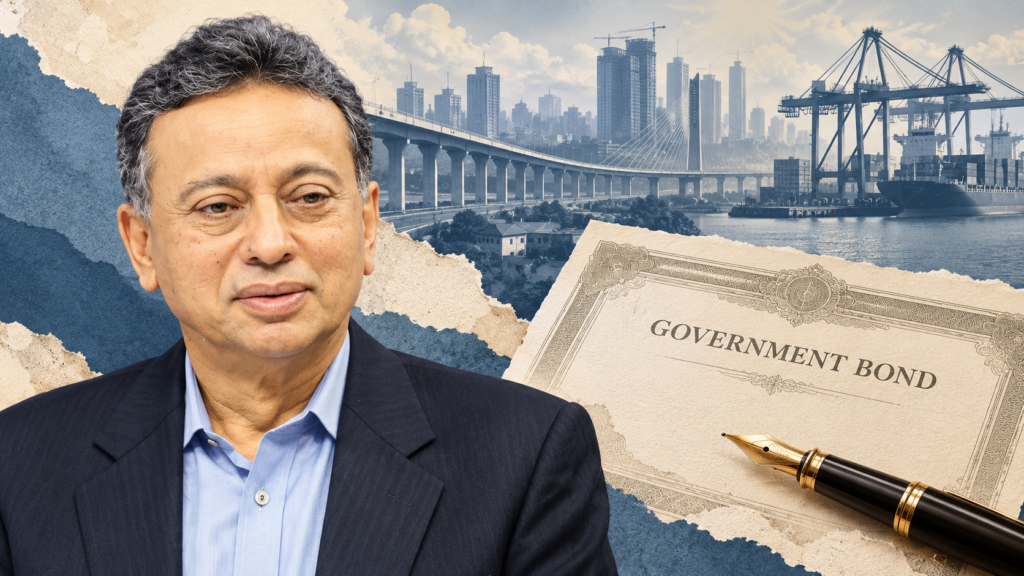
AI-generated editorial collage of Amir Khosru Mahmud Chowdhury with a symbolic government bond and infrastructure.
AI-generated conceptual editorial illustration. The bond document and infrastructure symbolise financing proposals; no issued security, agreed borrowing terms or actual event is depicted.

From 5 October 2026 — Daily Brief

Finance Minister Amir Khosru Mahmud Chowdhury has set out plans to raise more funding through bond markets, signalling an effort to broaden Bangladesh’s financing options beyond bank lending and international development institutions.

Speaking at the opening of World Investor Week in Dhaka on 4 October, he discussed borrowing through domestic and overseas securities markets. The options he outlined included dollar-denominated bonds and instruments aimed at Chinese and Japanese investors.

The minister said Bangladesh needed about US$50bn in financing annually. He also proposed using income-generating public assets to support securities issuance, citing bridges as a possible example.

Such financing would draw investors into instruments backed by future revenues rather than rely entirely on direct budget allocations. The remarks described a policy direction; the reports did not set out an issuance timetable or detailed borrowing terms.

Khosru also criticised conditions attached to International Monetary Fund support and said Bangladesh would reject terms it considered unacceptable. Reports differed on whether his remarks referred to cancelling a meeting or a programme, leaving the formal position unresolved.

His broader message was that a stronger capital market should finance more investment. Delivering that ambition would require specific offers, credible repayment arrangements and sufficient investor demand.

Business & Economy

Bangladesh and South Korea agree joint working group after trade deal

Finance and Planning Minister Amir Khosru Mahmud Chowdhury and South Korea's Trade Minister Jung-sung Park agreed in Seoul to form a joint government and private-sector working group following the countries' economic partnership agreement. He also met Samsung, Hyundai Glovis and Hanwha Ocean.

Business & Economy

Prime minister targets up to 4,000MW of solar power before next summer

Opening Bangladesh's first Solar Expo, Prime Minister Tarique Rahman set a target of 3,000–4,000MW of solar power on the grid before next summer. Surplus rooftop power will be bought at Tk 10.50 per unit under net metering until February 2027.

Business & Economy

Private-sector credit growth slows to 4.17% in September

Private-sector credit grew 4.17 per cent year on year in September, down from 4.75 per cent in August and below 5 per cent for a seventh month, Bangladesh Bank data show. Central bank officials said it was the lowest growth on record.

Business & Economy

World Bank says Bangladesh has two decades to use its demographic dividend

A World Bank report says Bangladesh's working-age share will peak in 2045 and the country will become an aged society by 2051. About 84 per cent of workers, around 58 million people, are informally employed, including 44 per cent of university graduates.

Business & Economy

Garment wage protests halt 306 factories as unrest enters fourth day

Workers demanding a Tk 30,000 minimum monthly wage clashed with police in Mirpur and blocked roads in Narayanganj and Savar. BGMEA said 306 factories with about 700,000 workers had stopped production by 11am. The new wage board says it will meet soon.

Business & Economy

German business confidence improves, but current conditions weaken

Germany’s Ifo business climate index rose to 90.2 in October from 89.9 in September. Expectations improved while assessments of current conditions slipped. The survey offers a modestly brighter outlook for Europe’s largest economy, without showing that output has already recovered.